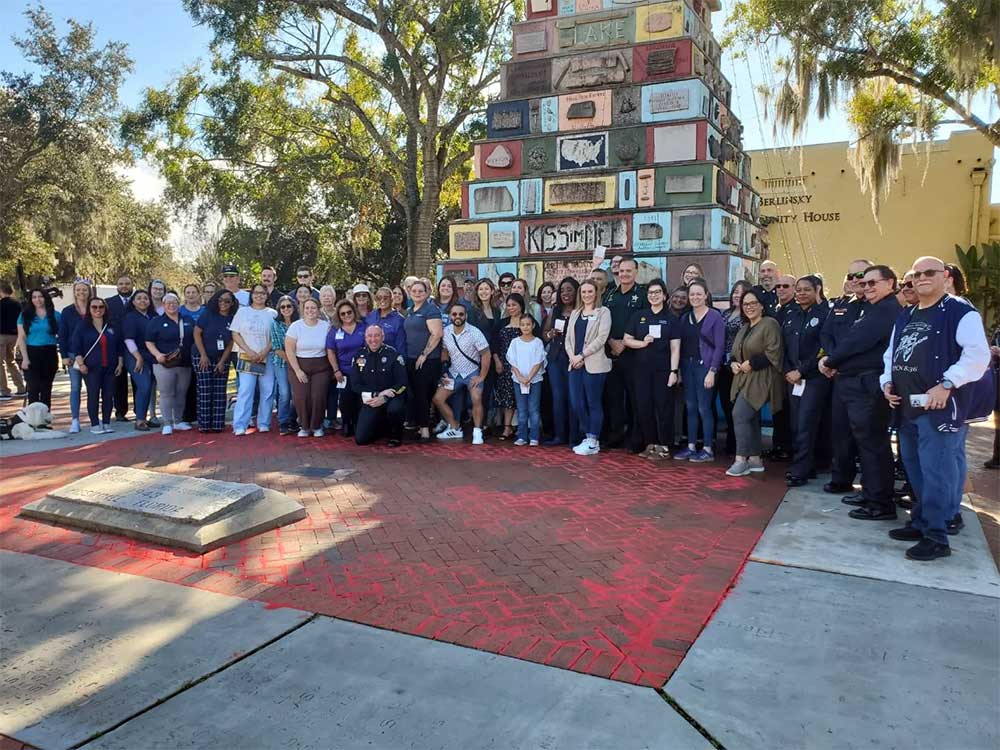
The Central Florida Human Trafficking Task Force held its seventh annual Red Sand Project on Saturday at the Kissimmee Civic Center. Law enforcement agencies and other agencies that offer wraparound care to survivors shared with community members ways they are working to combat human trafficking and support survivors in our area.
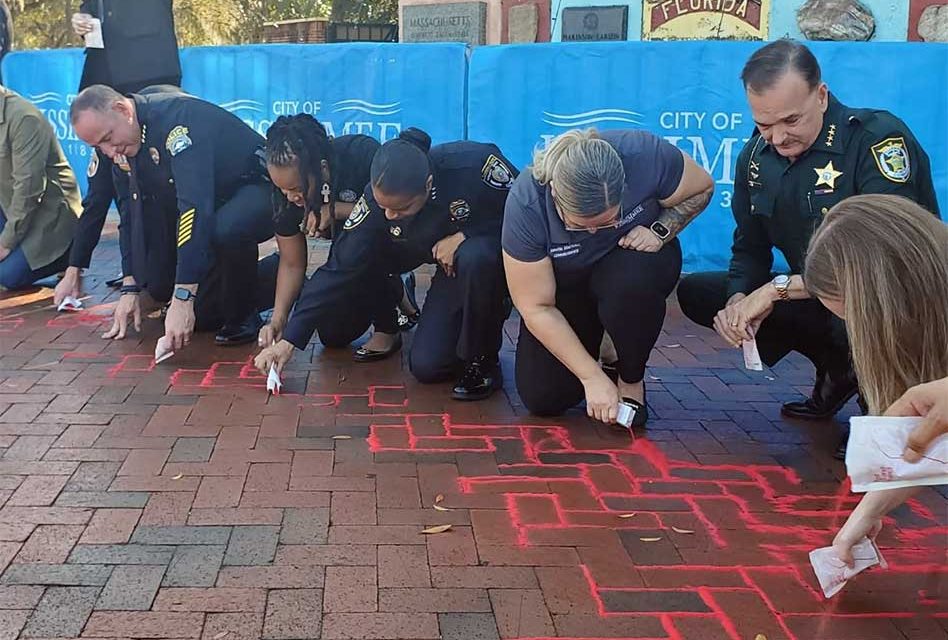
Afterward, attendees walked to the Monument of States to pour sand and fill the cracks between the bricks at the base of the monument. “Each grain of sand represents one person,” Osceola Sheriff Christopher Blackmon said. “Each grain of sand in the bag you have represents one person. The victims often go unseen, unheard, hidden in places where exploitation thrives.”
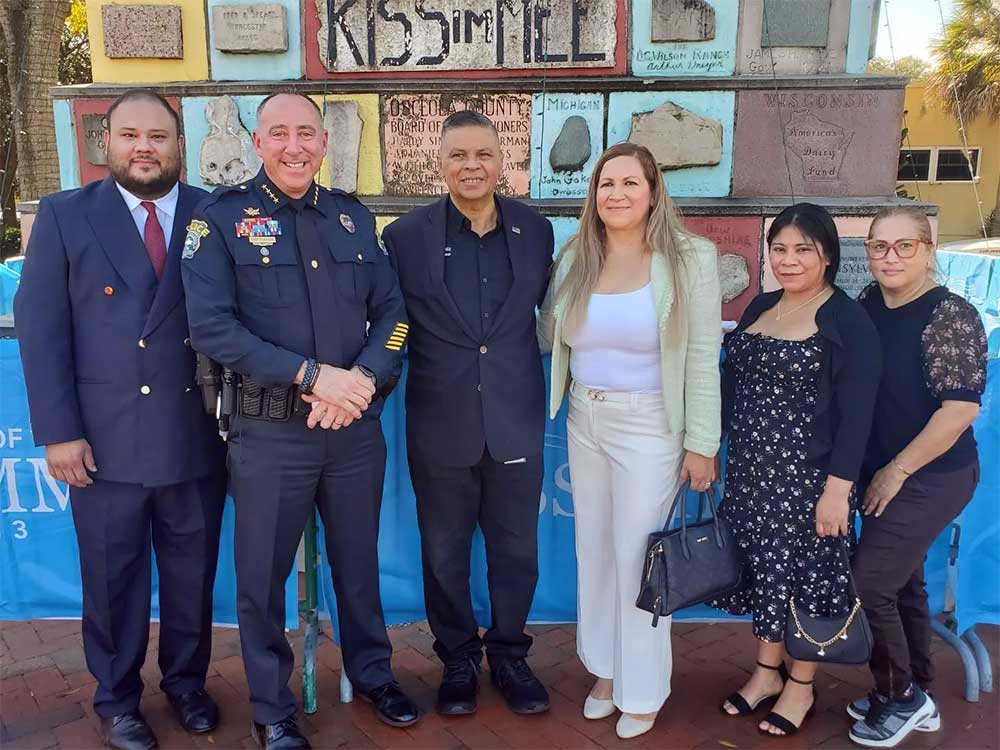
“Human trafficking is not an abstract issue or something limited to distant places,” St. Cloud Police Chief Doug Goerke said. “It’s real. It’s happening now. And it can affect any community, including ours. At its core, human trafficking is a form of modern-day slavery. It involves exploiting people, men, women, and children, through force, fraud, or coercion, for labor or sexual purposes. Victims are often hidden in plain sight, controlled through fear, manipulation, or dependency.” Goerke said that worldwide, an estimated 20 to 40 million people are caught in trafficking networks, generating about $150 billion in illegal profits annually. Florida remains in the top three across the United States, following Texas and California.
Human trafficking thrives in silence, Goerke said, so it is important to know and recognize the signs. He explained that victims may appear fearful, withdrawn, or anxious. They may lack control over their identities, finances, or movements. They may be coached on what to say or closely monitored by someone else. “Recognizing these signs is absolutely critical, because for many victims, a bystander noticing something that just isn’t right, is the first step towards freedom. If you see something, say something. Trust your instincts,” Goerke urged.
Florida State Attorney for the Ninth Judicial District, Monique Worrell, said protecting survivors and prosecuting traffickers is a priority for her office. “The University of South Florida estimates that 200,000 people were exploited in sex trafficking in 2024 alone,” she said, “with minors making up half of all victims.” Worrell said the true scope remains difficult to assess because many cases go undetected, making victims the hidden figures of this crime.
“Human trafficking is modern-day slavery,” she said. “Victims are forced, defrauded, or coerced into sexual exploitation. It strips people of their human rights and freedoms, reducing them to commodities to be bought and sold.” The crime of human trafficking centers on exploitation, Worrell said. She explained that while many people believe that human trafficking requires victims to be transported across state lines or borders, the crime does not require transportation. Human trafficking can be committed against someone who has never left their own neighborhood, their own street, or even their own home, she said.
Osceola County Corrections Deputy Chief Laura Rivera said that many victims of human trafficking pass through their facility long before they entered a courtroom or service provider, and they are working to help them get the resources they need. “Through our partnership with the Flite Center, we offer classes designed to educate the victims of human trafficking,” Rivera said. Twenty-two participants in 2024 and 41 participants in 2025 completed the Flite program.
“The Red Sand Project reminds us that human trafficking is not distant. It’s not abstract. It’s local. It’s real. And it often hides in plain sight. Today, as we place the Red Sand in cracks and corners, we’re making a statement that we see you, and we will not look away.”
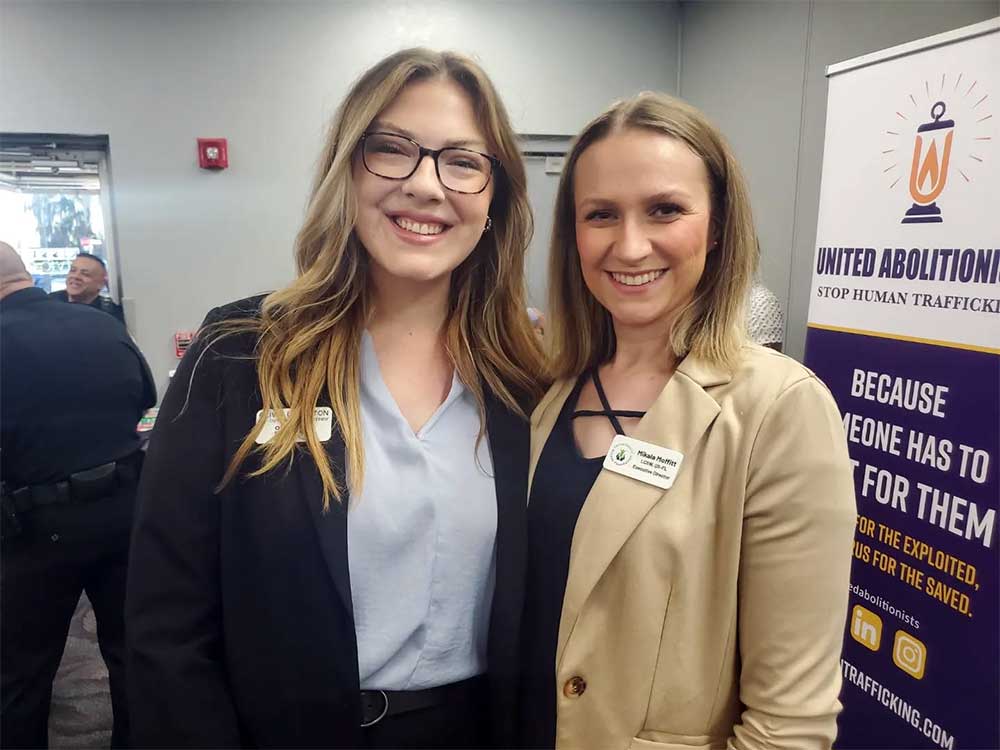
Mikala Moffitt, co-chair of the Central Florida Human Trafficking Task Force, said the Red Sand Project began in Miami in 2014 and is now in all 50 states and several countries. “The sand represents and symbolizes all of our victims and survivors that are falling through the cracks, whether that’s through economic, the criminal justice system, social services, or all of our adults and children that we’re missing,” she said. “This is to bring awareness to all of the injustices that are still happening within the survivors within our community.”
- Survivors like Stacie, who says her experience with human trafficking didn’t begin with a stranger. It began in her family.
She grew up in a multigenerational cycle of exploitation that started with her grandmother and continued through her biological mother. What was often described as domestic violence, she later learned, was trafficking – abuse exchanged for housing and safety. By the time Stacie and her siblings were young children, violence and exploitation were part of daily life as she and her siblings were exploited to their traffickers’ friends in the neighborhood.
She recalls frequent contact with authorities and child welfare workers, but says her mother was never allowed to speak freely. “We had a lot of missed opportunities by law enforcement and Child Protective Services,” she said. “We had a lot of times that they knew something was going on, but my mother was not allowed to speak. It was either her boyfriend or the trafficker that did the conversations.”
Stacie remembers wandering parks and public spaces late at night with her siblings, unnoticed. Eventually, the children were removed from the home and separated into foster care and adoptive placements.
For years, Stacie thought what happened to her was “just” abuse. The grooming shaped how she understood trust and relationships. As a young adult, she was trafficked again – this time by a female supervisor who offered housing and stability. The manipulation was gradual, built on meeting basic needs Stacie had never learned how to meet on her own.
Her exit came when a coworker noticed something was wrong and intervened. “I had definitely spiraled, was massive into drinking and self-harm,” Stacie said. “I just didn’t know what was going on. And finally, a co-worker was like, ‘Stacie, this does not look healthy. Something is going on.’ And I remember, I ended up just telling her.” When her trafficker left their apartment, the coworker helped Stacie pack and leave. Within weeks, Stacie enrolled in college, secured housing and work, and began rebuilding.
Today, she works with One More Child, supporting survivors as they define what healthy relationships look like for themselves. She says that approach matters because she didn’t identify as trafficked until long after she escaped.
- And survivors like Carly, who describes her early childhood as stable. Both parents had respected careers. Then addiction took over.
As methamphetamine consumed the household, stability disappeared. The family lost their home. They moved between hotels, and from the ages of 10 to 16, she says she was groomed and exposed to exploitation.
At 16, she was exploited through drug networks operating across Central Florida. “My mom was selling drugs and me,” Carly said. She moved through environments where adults, courts, and institutions saw her repeatedly but never identified her as a trafficking victim. Juvenile detention centers became familiar. So did hospitals. She says no one asked the questions that might have changed her path.
Addiction followed her into adulthood. Even after she stopped using drugs and earned her GED, she struggled to stay free. Without support that addressed trafficking-related trauma, she became homeless and unstable, cycling through crises.
“Then I found out about United Abolitionists, and I called them, and they got me into my first safe house,” Carly said. “I went through three. After the third one, I’ve been walking in victory.”
What helped was access to survivor-specific care – safe housing, therapy, and structured support – and her newfound faith. For the first time, she was able to address the trauma beneath the addiction.
“You can get a survivor sober. You can even give her a place to live. But without the wraparound care that addresses the fact that she’s been trafficked and begin to deal with that part of it, a lot of people don’t make it out as successful as they should,” she said.
Today, Carly works as a survivor leader, advocating for earlier identification and better systems. She says too many victims still pass through schools, courts, and hospitals without being recognized as victims.
- And survivors like keynote speaker Flor Turcio, who grew up in a small village in Mexico where food was scarce and school was out of reach. Girls were taught to obey men and endure hardship quietly. By age nine, she says, abuse was already part of her life, and silence felt mandatory.
As a teenager, Flor believed she had found love and protection. Instead, she was controlled and exploited, first in Mexico and later across multiple U.S. states. “My captors decided to send me to the United States. Just like merchandise for a gentleman, I was exported,” she said. For more than 20 years, she lived under constant supervision, moved frequently, and trained on what to say if authorities appeared. She did not know she had rights, or that help was possible. “I didn’t know that I was a victim,” she said. “I didn’t know I had a voice. I didn’t know that the officials that would raid the houses were there to protect me and that I can explain to them. I didn’t know my rights. I didn’t know my rights because I did not have access to a television, to a cell phone, to any type of external parties other than where I was living. The only thing I had and what kept me alive was the desire to one day see my children.”
Everything changed when Spanish-speaking federal agents took time to speak with her directly. For the first time, Turcio understood she was not at fault and that the law could protect her.
After a lengthy legal process, Turcio was reunited with her children. Those responsible for her exploitation were later sentenced to life in prison in Florida.
Today, Turcio works with law enforcement and advocacy organizations, focusing on outreach within immigrant and Latino communities. She speaks publicly so others know what she did not – that they have rights, and they do not have to stay silent.