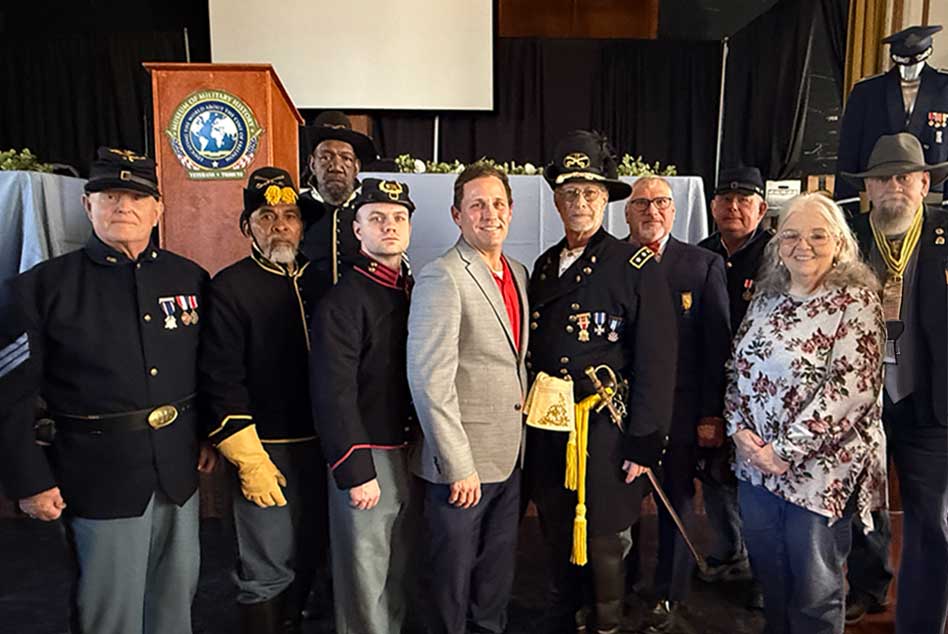
ST. CLOUD, Fla. — One of St. Cloud’s most significant historic landmarks has officially entered a new chapter. The Grand Army of the Republic (G.A.R.) Building reopened to the public on Sunday following a formal rededication ceremony, marking its transformation into a Civil War Museum and reaffirming the city’s long-standing identity as the “Soldier City.” The event was sponsored by Experience Kissimmee.
The free public event was hosted by the Museum of Military History and led by Executive Director and St. Cloud Mayor Chris Robertson, who addressed the importance of preserving the building not only as a historic structure, but as a living educational space.
“This building tells the story of who we are as a city and why St. Cloud exists,” Robertson said. “The rededication of the G.A.R. Hall ensures that the sacrifices, service, and values of those who came before us are preserved and shared with future generations. This is more than reopening a building—it’s recommitting to our history.”
Following the ceremony, attendees witnessed a celebratory firing of Civil War–period cannons, as men and women dressed in period clothing helped bring the moment—and the era—to life.
A Building Built for Memory
Completed in 1914, the 150-by-50-foot brick building was constructed by the G.A.R. Memorial Hall Association and funded through $8,000 in stock certificates, while the land was donated in 1909 by the Seminole Land Investment Company. The structure replaced an earlier “old hall” behind the current site, where St. Cloud was incorporated and its first civic officials were elected.
The Grand Army of the Republic, a nationwide organization of Union Civil War veterans active from 1866 to 1949, once maintained one of its largest posts in the country in St. Cloud. The local post was named after Lucius L. Mitchell, the city’s first veteran-resident to pass away, who is buried at Mount Peace Cemetery.
Inside the building, historical features once included inscribed brick panels honoring soldiers, a second-floor auditorium, and a painted curtain titled “Military and Community,” depicting veterans’ organizations such as the Women’s Relief Corps, Sons and Daughters of Union Veterans, and other civic groups that shaped early St. Cloud.
At its height, the G.A.R. hosted its final national encampment at the site. Over the decades, the hall continued to serve the community, hosting graduations, recreation, and even military use during World War II.
In 1943, historian Bruce Catton famously wrote of St. Cloud’s Union veteran community, “Something deeply and fundamentally American is found here.”
The building later passed through several caretakers before being deeded as a Florida Heritage Site in 1997.
Civil War Day and Evening Program
The rededication coincided with Civil War Day, a daytime event featuring reenactors, living history demonstrations, and educational programming. That evening, the G.A.R. Building hosted a Civil War Day Dinner, again led by Robertson.
The dinner program featured University of Central Florida historians Barbara Gannon, a G.A.R.T. and Civil War historian, and Scott French, a digital and public historian, both of whom spoke about the lasting importance of Civil War memory and public history spaces.
With the rededication complete, the Grand Army of the Republic Building will soon house Civil War memorabilia, artifacts, and interpretive exhibits, becoming another key historical destination for residents and visitors seeking to learn more about St. Cloud’s origins and military legacy.
Now reopened, the restored G.A.R. Building stands once again as a place of remembrance, education, and civic pride—connecting generations through the enduring story of St. Cloud, the Soldier City.