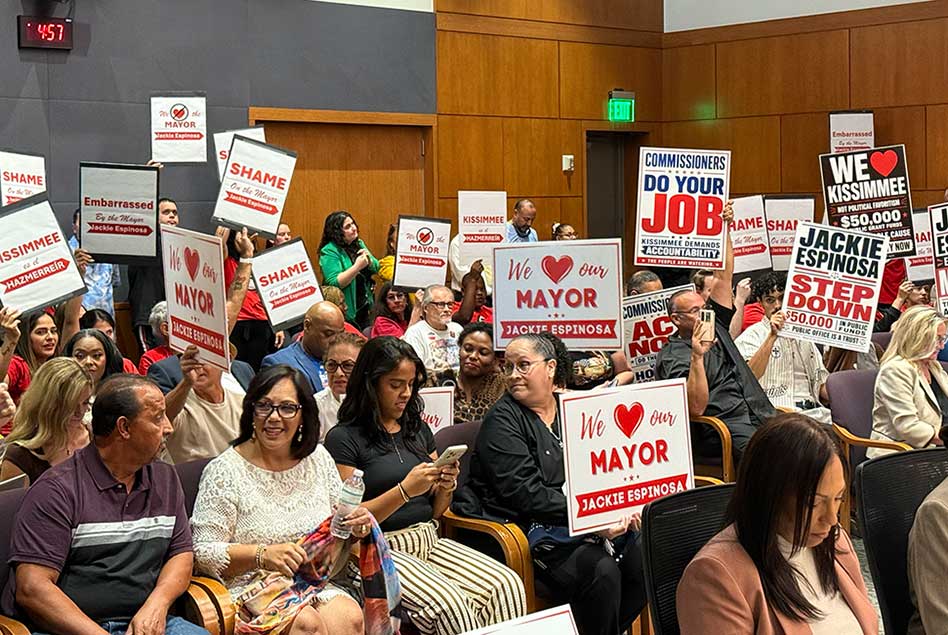
KISSIMMEE, Fla. — An effort to move impeachment proceedings against Kissimmee Mayor Jackie Espinosa to trial ended Tuesday evening after the City Commission deadlocked 2-2, leaving the proposed Articles of Impeachment without enough votes to advance.
Following the vote, Espinosa told Positively Osceola she was grateful for the community’s support throughout the process and made clear she intends to continue her work as mayor, saying, “Thank you. I am here to serve.”
Commissioners Janette Martinez and Vice Mayor Angela Eady voted yes to move the Articles of Impeachment forward, while Commissioners Noel Ortiz and Carlos Alvarez III voted no. With Espinosa not participating in the vote involving the proceedings against her, the commission’s 2-2 split meant the articles failed to advance.
The vote came during a special City Commission meeting called to consider findings from Special Prosecutor Mayanne Downs, who had determined there was probable cause to proceed with three articles stemming from allegations involving Espinosa and approximately $50,000 in Business Boost 2.0 grants received by three businesses in which the mayor or her family had an interest.
Because the commission tied 2-2, the articles were not accepted and Espinosa will not face an impeachment trial under those articles.
The outcome followed months of controversy surrounding the city’s ethics complaint process and an investigation that began after a complaint was forwarded for independent review earlier this year.
Special Prosecutor Argued Case Should Proceed to Trial
During Tuesday’s hearing, Downs laid out the case she believed justified moving the matter forward.
According to Downs, the city received federal American Rescue Plan Act funding and used a portion of that money for its Business Boost program. She told commissioners that Espinosa participated in three commission votes involving the program — including votes reallocating $1 million in December 2024, approving the program framework in April 2025 and adding another $375,000 to the grant pool in September 2025.
Downs said three applications totaling $50,000 were subsequently approved for businesses in which Espinosa had an ownership or financial interest. She identified First Advance LLC for $20,000, Kissimmee Diner for $15,000 and Real Estate Gallery LLC for $15,000.
At the heart of Downs’ argument was whether Espinosa’s participation in votes involving the broader grant program created a conflict under the city’s ethics code.
Downs argued that Espinosa neither disqualified herself from those votes nor disclosed a financial interest on the commission record.
Downs urged commissioners not to treat Tuesday’s proceeding as a determination of guilt, but rather as the point at which the case should advance to a trial where both sides could fully present their evidence and arguments.
“Your code says the special prosecutor has to find probable cause, which I did. Then your code says you proceed to an impeachment trial,” Downs told commissioners, adding that Espinosa would have the opportunity to present her defense during that proceeding.
Had the articles advanced, an impeachment trial would have been scheduled within three months. Instead, the tie vote stopped the process at Tuesday’s stage.
Espinosa’s Attorney Challenges Evidence and Fairness of Process
Espinosa’s attorney, Migdalia Perez, presented a sharply different interpretation, arguing that the commission was being asked to take the extraordinary step of advancing impeachment based on disputed legal conclusions rather than findings of guilt.
Perez emphasized at the outset that the Articles of Impeachment themselves were “not evidence” and “not findings of guilt,” and argued commissioners needed to determine whether the evidence was sufficient and the process fair before allowing an impeachment proceeding that could ultimately overturn the decision of voters.
The defense also challenged the fairness of the city’s process, arguing that commissioners — rather than judges or ethics-law experts — were being placed in the position of resolving complicated legal questions.
Perez further argued that Espinosa did not approve her own grant applications, direct city staff to approve them, change eligibility requirements or request preferential treatment. According to the defense, city staff administered Business Boost 2.0 under published requirements and eligible applicants received funding according to established criteria.
The defense also drew a distinction between Espinosa voting on the creation and funding of a program available to qualifying businesses and voting specifically to award money to her own businesses.
“Votes to establish a fund, a general program, is not the same as voting for an award for yourself,” Perez told commissioners.
Perez argued that determining whether a conflict existed required examining what Espinosa knew and intended at the time of each vote, including whether a particular business had applied for or been approved for funding at that time.
She also maintained that the city’s impeachment case was improperly relying on questions of Florida state ethics law that should instead be addressed by the Florida Commission on Ethics. The defense urged commissioners to reject the articles and allow the state ethics process to run its course.
Perez told commissioners that Espinosa was prepared to reimburse the city if the Florida Commission on Ethics ultimately determined the funding constituted a prohibited contractual relationship.
Months-Long Ethics Dispute Ends Without City Impeachment Trial
The controversy began earlier this year when Kissimmee resident Alexander Alemi filed an ethics complaint concerning Espinosa’s connection to Business Boost 2.0 funding.
In April, commissioners voted to forward the complaint to the Ninth Judicial Circuit for review and appointment of a special prosecutor. At the time, Espinosa recused herself from voting on the matter.
Downs ultimately found probable cause and filed Articles of Impeachment, bringing the matter back before commissioners Tuesday to determine whether those articles should advance to trial.
The 2-2 deadlock was significant because Tuesday’s vote was not itself a vote on whether to immediately remove Espinosa from office. Approval of the articles would instead have triggered an impeachment trial, where evidence and defenses could have been presented before commissioners considered whether removal was warranted.
Because the articles failed to advance, that trial will not take place under this proceeding.
Espinosa Responds to Positively Osceola: “Gratitude”
Following the commission’s decision, Espinosa spoke directly with Positively Osceola, expressing appreciation for those who supported her throughout the months-long controversy.
“I think the word that defines what I’m feeling right now is gratitude,” Espinosa told Positively Osceola. “Gratitude, number one, to God, and number two, gratitude to the community that has shown so much support throughout this entire journey.”
Espinosa concluded her comments to Positively Osceola with a message about continuing in her role as mayor:
“Thank you. I am here to serve.”
Tuesday’s vote brings the city’s impeachment proceeding against Espinosa to an end without a trial, after commissioners were unable to reach the majority needed to advance the Articles of Impeachment.