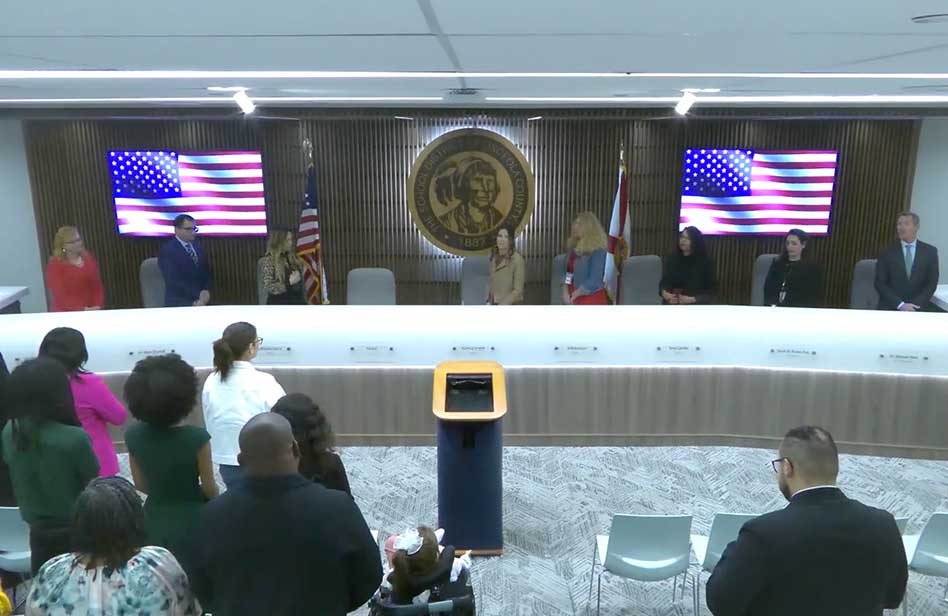
At Tuesday’s Osceola County School Board meeting, Superintendent Dr. Mark Shanoff shared that the district achieved its highest graduation rate on record in the 2024-2025 school year.
Shanoff reported that the district’s graduation rate climbed to 91.1%, up from 84.8% in 2022-2023, reflecting significant progress over the past two years. “We celebrate the fact that 91.1% of our students graduated,” Shanoff said. “But we also recognize that means 8.9% did not, and that is something that we continue to work on.”
Shanoff credited principals across the district for maintaining a strong focus on student outcomes. “The culture now within our district is, we expect you to graduate,” Shanoff said. “So when students walk through our doors, when they register … it’s not just a goal. It is the expectation. Students will walk across the stage. Students will receive their diploma.”
Osceola County non-charter district schools reached a 93% graduation rate, exceeding the state average. Several specialty schools—including NeoCity Academy, Osceola School for the Arts, Professional Technical High School, and Osceola Virtual School—maintained 100% graduation rates.
Individual schools also posted notable improvements. Gateway High School increased graduation rates for students with exceptionalities by 19 percentage points, while Celebration High School improved graduation outcomes for students eligible for free and reduced lunch by 6.8 points. Liberty High School reported a 12.2-point increase in graduation rates among English Language Learners.
To sustain progress, Osceola schools monitor student performance as early as freshman year using real-time data dashboards and graduation progress plans. Shanoff emphasized that continued success is rooted in a shared belief that every student can succeed when given the right support.
The superintendent also highlighted strong postsecondary outcomes, with 62% of graduates enrolling in a Florida public college or university. Shanoff credited the Osceola Prosper program for helping remove financial barriers and expanding access to higher education. “Before Osceola Prosper, we were at 62 out of 67 counties,” he said. “Our students were not going to college because they could not afford it. Our county commission has provided that pathway for our students. They are leading the way in showing where the intersection of county government and the school district should be.”